Cortex AI Analítica
"Análisis de relevancia para la actualidad."
- L ike many Ukrainians, Oleh Kupchak was delighted when Péter Magyar won Hungary’s election last weekend, ending Viktor Orbán ’s 16-year grip on power.
Ukraine celebrated Orbán’s landslide defeat in a series of jokes and memes. Several likened him to the Star Wars character Jabba the Hut, and shared an image of Orbán fleeing from a drone. Others portrayed him sitting on a bench in Russia, alongside Ukraine’s pro-Kremlin former president Viktor Yanukovych, and his exiled Syrian counterpart Bashar al-Assad.
The widespread joy that greeted the ousting of Orbán and his Fidesz party was hardly surprising. Hungary’s outgoing prime minister – the Kremlin’s biggest and most disruptive supporter inside the EU – ran a vociferously anti-Ukrainian election campaign. He accused Kyiv of plotting to sabotage key energy installations, and of threatening him and his family with physical violence.
Recently Kyiv’s already brittle relations with Budapest had descended into open hostility. In late January a Russian drone set fire to the Druzhba pipeline, which supplies Russian oil to Hungary and Slovakia. Orbán claimed Volodymyr Zelenskyy was deliberately delaying repairs, causing a fuel shortage in Hungary, in order to damage Fidesz’s re-election chances.
In the run-up to the poll, Hungarian voters encountered billboards showing Zelenskyy begging for money from the EU. Other posters featured photos of Ukraine’s president next to Magyar. The opposition leader and his Tisza party were accused of trying to drag Hungary into the fighting in Ukraine, and being a part of a Brussels-backed “pro-war lobby”.
Ukrainian politicians and analysts welcomed Magyar’s victory, but downplayed expectations of a quick thaw in relations between the two previously embittered countries. Oleksandr Merezhko, the head of the foreign affairs committee in Ukraine’s parliament, said he felt “cautiously optimistic”. “A unique window of opportunity is now opening up for Ukrainian-Hungarian relations,” he told the Guardian.
Merezhko interpreted Hungary’s election results as “on the whole a win for Ukraine”, since they represented “a strategic defeat for Putin”. “Putin had hoped to form an anti-Ukrainian coalition in Europe led by Orbán, which would also include Slovakia and the Czech Republic. Putin’s plan has failed. Without Orbán in power, such a coalition will not form,” he said.
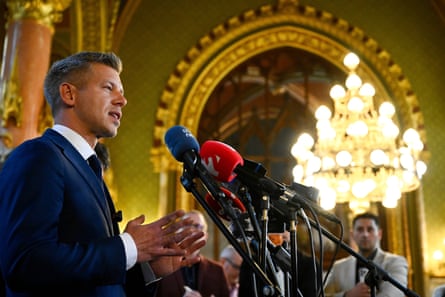
Peter Magyar, the Tisza party’s leader, speaks to the media after the preparatory meeting for the inaugural session of the parliament in Hungary. Photograph: Robert Hegedus/AP
Magyar is expected to lift Orbán’s veto on €90bn in EU aid to Ukraine, once his government is sworn in early next month. Kyiv badly needs the money. Hungary is also expected to drop its opposition to new sanctions against Russia. With Orbán gone, Brussels will unlock EU funds earmarked for Hungary suspended because of democratic backsliding.
Merezhko described Hungary’s new leader as more “constructively minded” than his pro-Russian predecessor and “not anti-European”. The deputy, however, warned that all bilateral issues could not be resolved “automatically and quickly”. “Magyar now needs to show Europe that his policy will not be a continuation of Orbán’s. And here, the issue of Ukraine is key,” he said.
One potential dispute is over Ukraine’s EU accession. Magyar has said he would not oppose Kyiv joining the bloc, but rejects fast-track membership for Ukraine, and says the issue should be put to a referendum. Another is the status of Ukraine’s ethnic Hungarian minority. The small community in the western Zakarpattia region has long been a source of tension, exploited – Kyiv says – by a cynical Orbán.
Last month Budapest impounded two Ukrainian armoured bank vehicles carrying millions of euros as well as bars of gold. Orbán had unlawfully seized the funds, Merezhko said, in a provocative scandal. “A very significant step, and a clear sign of Magyar’s willingness to engage in dialogue, would be for him to return the Ukrainian funds,” he added.
Last weekend Zelenskyy sent a message of congratulation to Magyar and his Tisza party. “It is important when a constructive approach prevails,” he noted, adding that Ukraine had always sought good neighbourly relations with “everyone in Europe”. Ukraine was ready to develop “cooperation with Hungary” and to meet and work with its new government, he said.
In contrast to the Trump administration, Magyar has stated Ukraine is a victim of Russia’s invasion and should not be forced to hand over its territory. In July 2024 he travelled to Kyiv, shortly after Moscow bombed the Okhmatdyt children’s hospital. He paid tribute to Ukrainian soldiers killed in the war and handed over humanitarian aid and a donation.
However, Ukrainian commentators think Magyar should not be seen as a friend or booster. “Magyar is not a pro-Ukrainian politician. He is pro-Hungarian,” Serhiy Sydorenko, the editor of the European Pravda newspaper, wrote this week. He suggested Zelenskyy would reluctantly complete repairs to the Druzhba pipeline, allowing limited Russian oil exports to resume to Hungary, as a gesture of political goodwill.
Other observers said Hungarian society had grown used to anti-Ukrainian narratives, after 16 years of Orbán propaganda, and would take time to change its views. “We can’t expect something very liberal from the reformist government,” said Marianna Prysiazhniuk, a political analyst with the Democratic Initiatives Foundation in Kyiv. She added: “What we’ve witnessed in Hungary is the reconsolidation of power.”
Prysiazhniuk believes Zelenskyy should behave “very delicately” towards Budapest, taking into account its “internal context”. “We shouldn’t expect Magyar to shout: ‘Glory to Ukraine’. The priority is for Hungary to become a reliable European partner,” she said. The two leaders are likely to hold talks next month in Romania at a meeting of the “Bucharest Nine”, a gathering of Nato’s formerly communist east European member states.
Kupchak, meanwhile, said he had driven several times to Hungary from his home in Lviv. It was a day-long journey via the Chop border crossing, through the scenic foothills of the Carpathian mountains. “In my opinion the Hungarians have a bit of an imperial mentality, similar to the Russians. It’s a hangover from the Austro-Hungarian empire. We hope that under Magyar this changes,” he said.
Galería de Imágenes